
Setting Credible Net Zero Targets: A Guide
Setting a Net Zero target is on the mind of many businesses in the UK, and rightly so. Pressure from large customers, clients, staff and investors is driving sustainable best practice through their value chains as they manage their own risk by aligning core values with those they work with. Whether a business holds sustainability as a core value itself or not, there is commercial value to be gained from demonstrating responsible business practice to relevant stakeholders. Working towards Net Zero is still one of the best and most accessible ways to reduce negative impacts on the climate.
Setting a Net Zero target demonstrates a commitment to sustainable and responsible business that can be communicated clearly to stakeholders. Working towards this target will promote competitive advantage, manage business risk and cost volatility, and satisfy stakeholders working for or with your business. But, as with any strategic business decision, these targets need to be well thought out. They need to be credible ahead of being made public to ensure they do not carry risk of reputational damage down the line. Setting unfeasible targets could lead to greenwashing claims or hit the confidence of customers that are expecting contributions to their own decarbonisation, removing the value the Net Zero target brought your business in the first place. These are straightforward risks to mitigate; businesses just have to go through the necessary steps to set an appropriate, credible pathway to Net Zero.
Many early Net Zero targets are now being restated. Ambitious target dates originally set for between 2030 and 2040 are now being pushed back to closer to 2050, the year the UK has legally bound itself to achieve Net Zero. Many targets set in the years following the 2015 Paris Agreement have been found to be unfeasible, particularly across Scope 3 emissions from procurement, travel, commuting, product emissions, and other indirect emissions sources. The definition of Net Zero has also been refined considerably in more recent years, leading to a consistent understanding of what Net Zero in business really means, that was not necessarily adopted when setting early stage Net Zero targets.
This is not a criticism of early adopters of Net Zero targets; the industry has learned a lot about what it takes to reach Net Zero, and there is now a wealth of data that can be used to inform target setting that would not be available if it wasn’t for these early adopters. But what this trend does highlight is the need to use data to evidence sustainability targets, and the need for businesses to treat this as an important strategic business decision. It is not something to just ‘follow the crowd’ on, or knee-jerk into setting targets that are not specific to your business context.
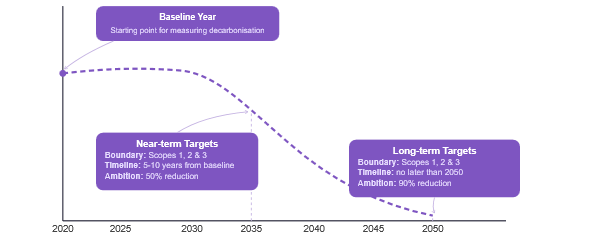
Under global best practice set out by the Science Based Target Initiative (SBTi), a credible Net Zero target has three main components:
A baseline year: The year from which progress against decarbonisation is measured. See this as the starting point of your Net Zero journey.
An absolute Net Zero (or long-term) target year: The year a business commits to achieving Net Zero, often set at 2050 unless businesses can demonstrate an opportunity to be more ambitious. Businesses are required to achieve a 90% reduction from their baseline footprint by this date.
An interim (or near-term) target year: A specific decarbonisation target to be achieved relative to the baseline footprint, within 5-10 years of the baseline year. This offers an opportunity to take stock on what’s working, how plans may need to change, and how industry decarbonisation or business context is affecting progress.
Support on setting Net Zero targets is provided through freely available guidance from standard-setting bodies such as the SBTi, but they can be difficult to interpret for some businesses and they contain technical jargon that is new to many. Consultancies are on hand to support, too, helping businesses break through this complexity to provide clarity on how decarbonisation can add value, and how to set realistic, feasible, ambitious, and evidence-based Net Zero targets.
Kurb Carbon have developed a proven process for setting appropriate Net Zero targets, and are now helping organisations set and communicate targets in a way that enhances brand and protects reputation. Our process is broken down into 4 clear steps:
Know your impact: Calculate the carbon emissions from your business in line with best practice.
Forecast your impact: Use this inventory and readily available datasets to forecast your emissions out to 2050. This tells you not only where your impact is today, but where it is expected to be when you consider business growth and industry decarbonisation.
Define % reduction requirements: Set annual % reduction targets against forecasted emissions.
Design specific interventions, projects and operational changes that will realise the % reduction required up to 2050.
This data-led process gives confidence that commitments being made for sustainability are feasible, and, it provides clarity on what it really takes to reach Net Zero for UK businesses. This is vital for board sign off, and allows consideration of sustainability agendas alongside other critical business decisions.
If you would like to talk through how a Net Zero target can help satisfy your stakeholders, customers or investors, and would like to discuss how you can set appropriate Net Zero targets, drop our experts a line at info@kurbcarbon.co.uk.